VALO RESEARCH

Make repeated AI work
economically better.

Your product stays the product.

EXUP takes one existing, repeated AI workload and tests whether accepted outcomes can become cheaper, faster or less dependent on repeated compute and human intervention — without reducing the agreed quality.

The next run should not have to pay for all of the work of the last one. EXUP verifies whether improvement can be retained in production and measures the value only while it remains real.
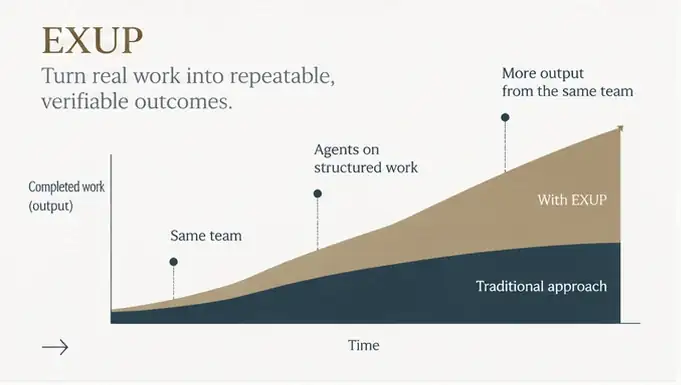
Illustrative EXUP capacity model
Illustrative capacity model · actual value requires a measured baseline and verified result.

EXUP — video

EXUP execution telemetry · illustrative interface. Concept or illustration; not proof of a measured outcome.
Lock the existing baselineStart with one repeated workload, its accepted outcome and its current economic cost.
Improve and retainTest whether later accepted outcomes require less cost, latency, retries, compute or human intervention.
Verify realized valueThe acceptance gate stays fixed. Value exists only while the measured improvement remains real.

More work usually means more people. Break that dependency.

The constraint is often specialist attention: review, coordination, judgement, exception handling and follow-up. EXUP targets the constraint, not the technology fashion.

Baseline

Freeze current accepted output, human attention, cycle time and resource cost.

Control

Define what “good” means before any improvement is counted.

Intervention

Use the smallest change capable of increasing completed outcomes.

Retain

The gain must survive repeated work and production measurement. If it disappears, the value claim disappears with it.

Proof before claim.

+10%100 accepted outcomes become 110 with the same constrained resource.
+25%100 become 125 before adding equivalent headcount.
0Allowed quality degradation at the agreed acceptance threshold.
RepeatThe result must remain reproducible under the agreed measurement.

Illustrative arithmetic only — not a claim of customer savings or expected EXUP performance.

Inspect the value stories.

Case throughput

5 minutes saved × 520,000 accepted cases ≈ 43,333 hours/year.

Capacity is valued from the customer’s actual constrained resource and verified outcome, not from token savings.

Analyst leverage

2 minutes saved × 1M accepted analyses = 33,333 hours/year.

The relevant unit is accepted analysis per analyst hour, with the same quality gate for control and intervention.

Specialist leverage

20 → 25 accepted workflows per specialist = +25% capacity.

The value exists only if the additional work survives the same acceptance criteria and repeat measurement.

Start with one valuable piece of work.

If it has a defined outcome and a measurable baseline, we can test whether better economics are possible.

Define the pilot →

No verified improvement, no value fee. Commercial terms are agreed per bounded engagement.